2025 in Books
My year in books

This year, I read way more books than I expected I would.
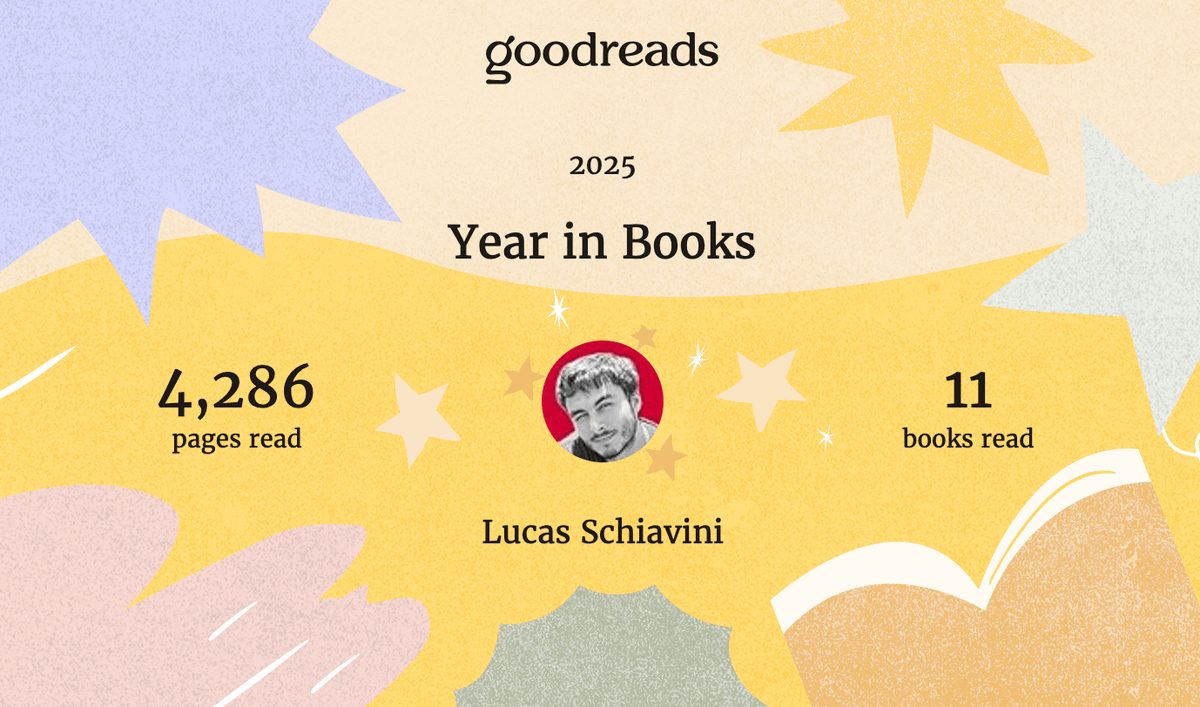
It was a difficult year, changing cities, visa processes, citizenship processes(Adesso sono italiano — I'm Italian now🇮🇹🍕👌), and businesses launched(money tracking app, software agency).
So it surprised me that even though all that was going on, I kept the healthiest habit I have, reading.
So here's my year in books. What I thought about each, feel free to skip to the section you find the most interesting. I'm dividing this post into 3 sections:
- Fiction(Frank Herbert, Dunsany, Tolkien, Sonia Zaghetto—a friend of mine)
- Non Fiction(philosophy, biographies, history, futurology)
- Parting Thoughts
So let's begin.
Fiction
I started the year reading the third book in the first Dune trilogy. Children of Dune.
Children of Dune
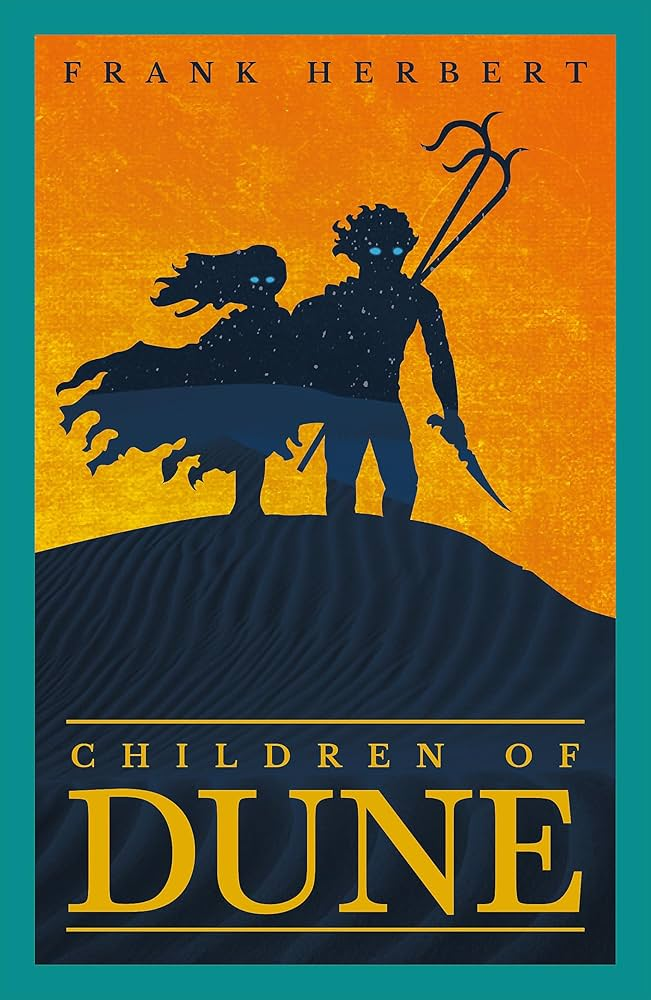
It's the closing chapter of the story started with Paul Muadib Atreides, and follows his two children. The best way I can describe this is: It's the most ambitious sci-fi story I've read so far. I would have been surprised to see it being written today, never mind decades ago.
Frank Herbert's understanding of psychology and seeing things through to their realistic end in a fantasy world is amazing. Without spoiling for people who haven't read the other books or haven't watched the movies, this reads as a Greek Tragedy in space. It's chilling, and you feel every sacrifice made.
But because of it, I grew very depressed after finishing it. I needed a palate cleanser.
King of Elfland's Daughter
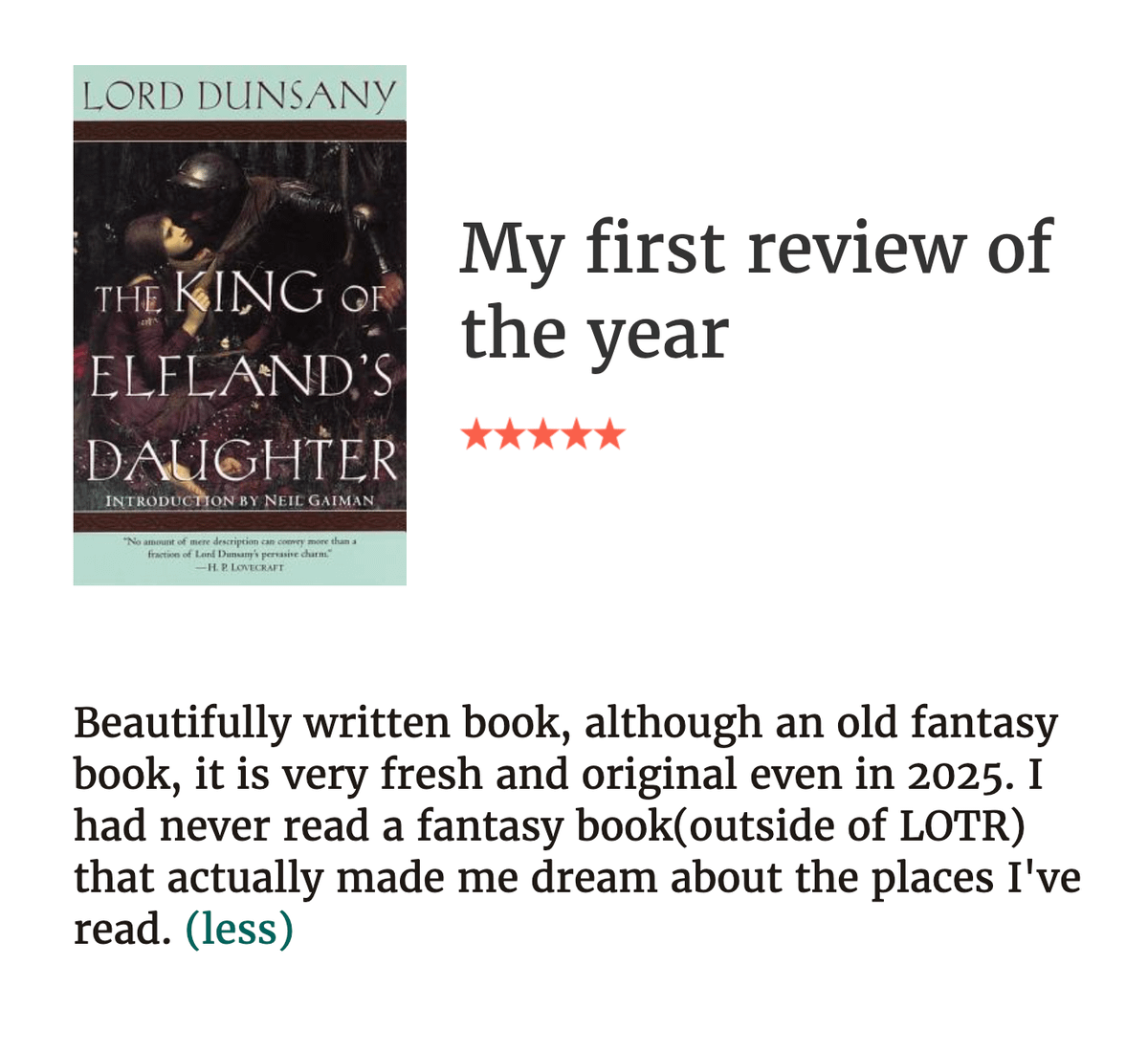
By far the best fiction I've read this year, after being very depressed at the end of Children of Dune, I decided to read fiction that wouldn't make me depressed anymore, haha(which eventually led me to Tolkien).
This book was a rare find. I looked at "fantasy books that weren't turned into movies yet," and this came out.
Dunsany is a poet, and this book transforms the way you view fantasy by the way it is written. It reads like a long poem, with repeating mantras that get you to the other side of things you know. Beyond the fields we know. Every paragraph rhymes with the next, entire chapters rhyme with others and you just feel yourself entering this trance and deeper and deeper into the story. I haven't felt this with any other book before. If you want to read a beautiful story that engages your imagination, I can't recommend this enough.
Dunsany has also been the inspiration of great novelists like Ursula Le Guin, Arthur C. Clarke, Lovecraft, and even Tolkien himself.
Talking about the good professor...
The Hobbit
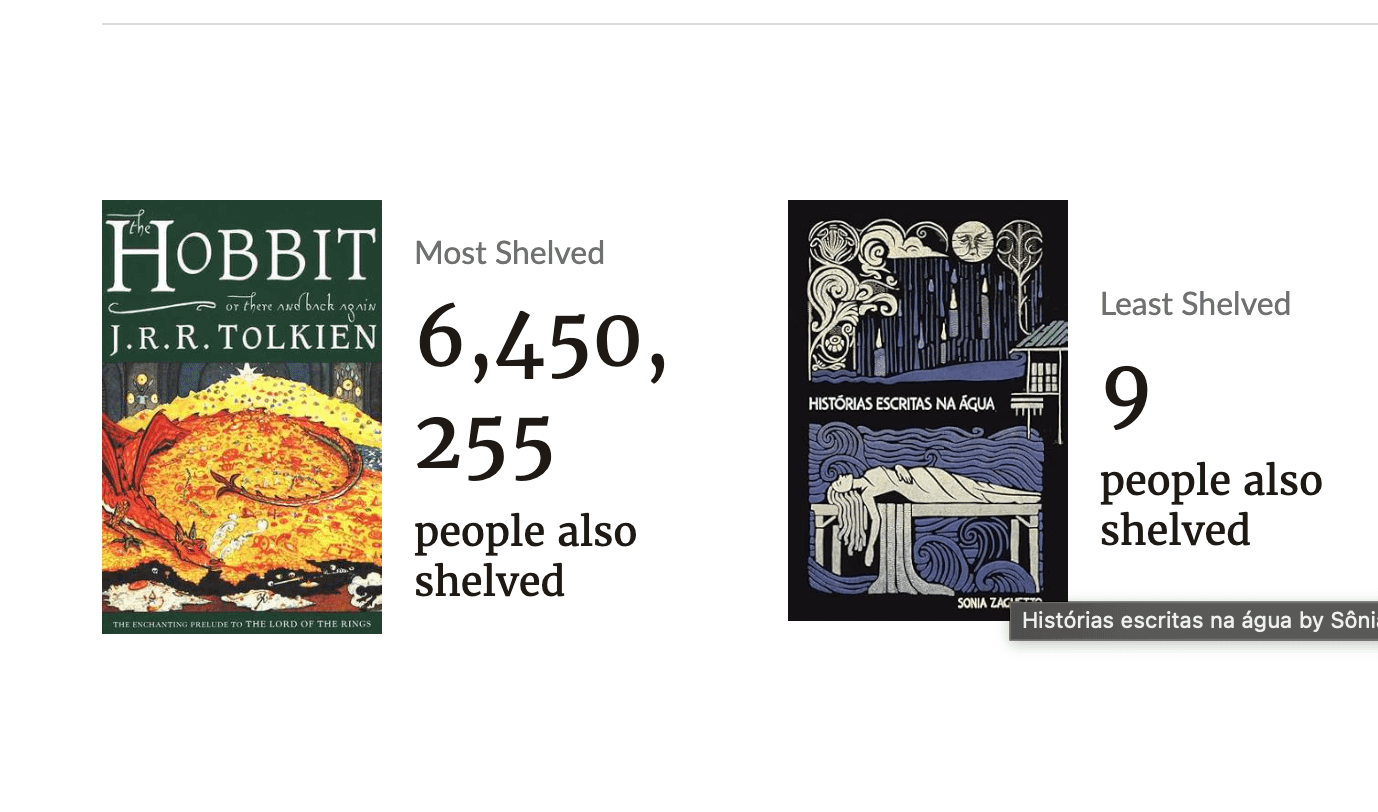
After years of hating Lord of the Rings movies, I caught myself watching it again during the pandemic and couldn't stop crying watching it. Something in me changed that stopped seeing the movies as "boring" and started recognizing how real they were, behind all the high fantasy.
If there ever comes a point in your life when you think you have lost your strength, when the world is a huge ball of fear you must face every single day, and you become a coward. And then something reminds you of the strength you have, and that it hasn't left you. Then you will understand King Theoden.
If you ever feel small in the face of grave danger and choose to fight it anyway because there are more important things than the things you fear, you will understand Frodo and Sam.
It's a beautiful story, but I haven't read any of the books until this year. After Dunsany, though, I decided it was time.
I finished reading The Hobbit the night before Christmas. I loved reading it, although I must confess Tolkien's prose wasn't as fantastical as Dunsany's was to me. But I enjoyed the book thoroughly. The good professor managed to create a whole world that makes you wanna live in it.
I'm now on my way to finish The Fellowship of the Ring, and I'm eager to see how it plays out differently from the movies.
Histórias Escritas na Água by Sonia Zaghetto (Stories Written in Water)
This book, called "Histórias Escritas na Água"(Stories Written in Water), was written by a good friend of mine who has led a brilliant career in journalism that is now venturing into literature.
It's a book that mixes multiple mythologies from all over the world, with stories that deal with guilt, regret, and painful memories. Each chapter has a different story that then gets joined at the end.
I love it when authors don't try to control the narrative or pass a specific message. She wrote the book according to what the characters' own motivations were. She often said it was as if the characters were sitting next to her, whispering what happened into her ear.
I highly recommend her book if you speak Portuguese; if not, I'll let you know when a translation comes out.
Now onwards towards nonfiction.
Non Fiction
By far the most influential books on me this year were Leisure: The Basis of Culture and Elon Musk's Biography by Walter Isaacson.
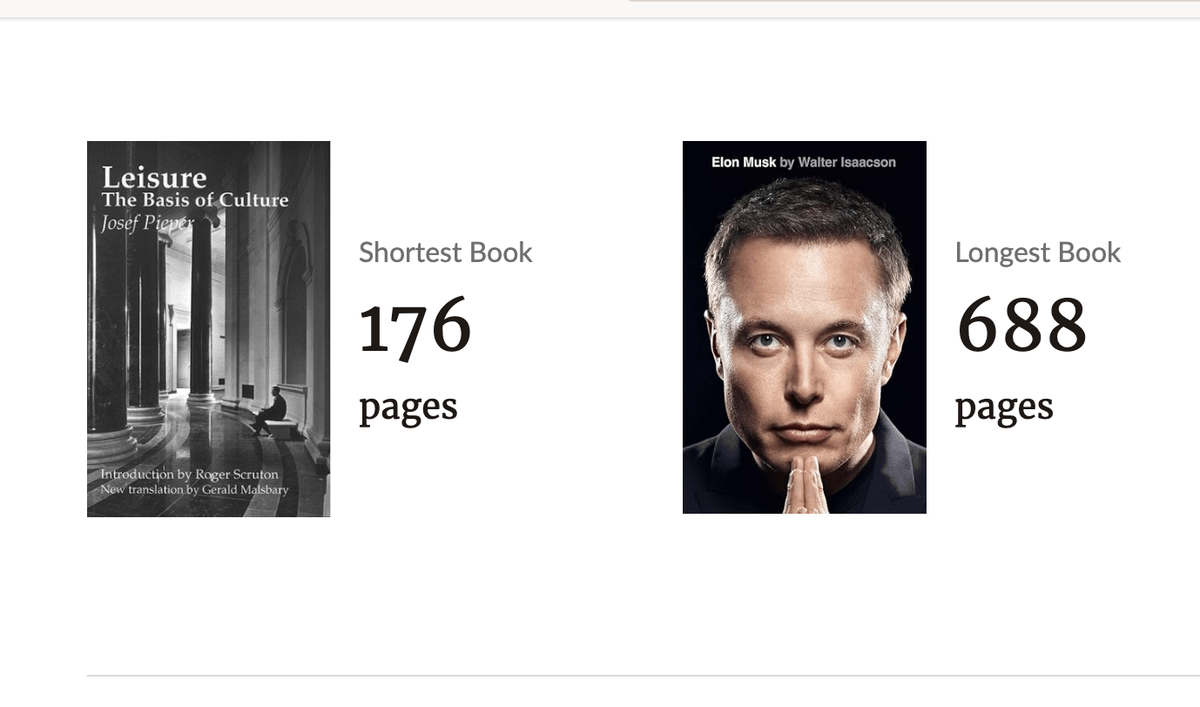
Elon's Bio
The key idea I think is valuable in Elon's book is his algorithm. This is the gist of it:
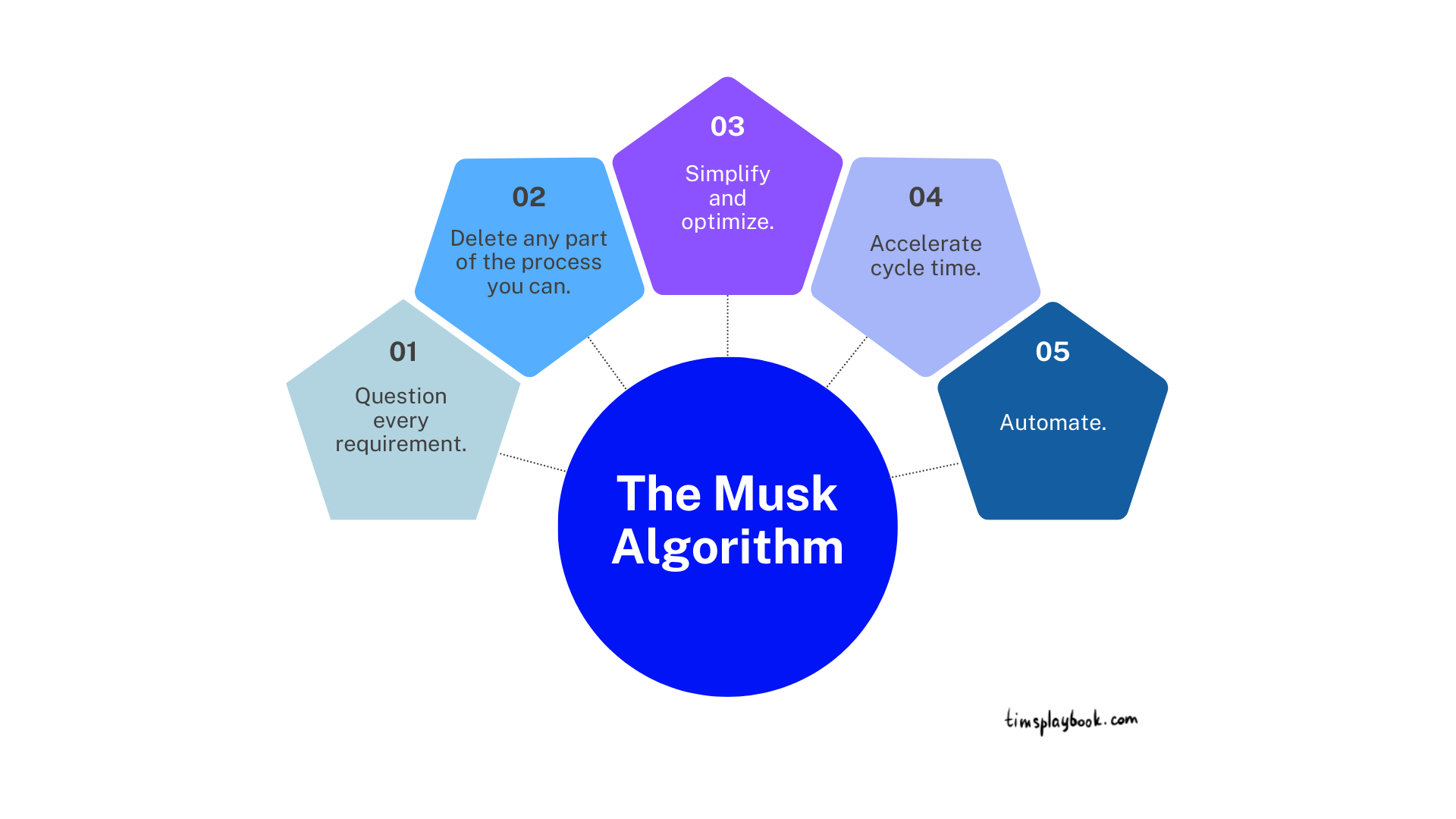
Now that you see the algorithm, should you still read the book? I think so, as you see him failing his way into developing it, it gives a lot of context that just seeing a graph online won't.
You will know that "question every requirement" came from him starting SpaceX, and seeing smarter people than him use requirements that were obsolete and should have been questioned anyways. And why not questioning it caused problems.
In fact, that's the key point he makes on step number 1: you should question your requirements, especially if the person who gave them to you was smart. Smart people might be less eager to retest assumptions, but innovation sometimes requires you to play dumb and try to do things from first principles.
There's also the Automate bit coming at the end. I'm a Mechatronic engineer; it is my instinct to automate everything I can. But I too, have seen what problems come from premature automation. You should do things that don't scale first and from the raw human heuristics, you will then be in a very good position to automate.
Elon has made that mistake building the first Tesla factory, adding robots everywhere, only for them to be inutilized as there was a huge lack of knowledge of the specific problems in their manufacturing. He then had to bring back a bunch of people to get things moving every step of the way.
Elon's algorithm is a great thing to keep in mind, especially if you have been educated as an engineer and want to build new things.
So this is an interesting book if you are an entrepreneur and want to learn from Elon's mistakes.
On the complete opposite end of the spectrum, the next book, Leisure, teaches you that real philosophy has no goal; it is purely autotelic.
Leisure: The Basis of Culture by Joseph Piper
This was a rare find. The shortest book in the year and possibly the one that made the biggest impact on me. Piper tells the story of how philosophy was created as a field, and how it was transformed into something it wasn't meant to be.
At first, he reintroduces the term Liberal Arts. If you are college-educated, you probably know what it is. Well, do you?
Nowadays, liberal arts are at the study sitting on the opposite end of STEM( engineering, maths, etc). But it's hard to define what it is, as we are constantly redefining terms, and "arts" and "liberal" being one of them.
He reintroduces the terms from their original meaning. Liberal arts as "artes liberales", on the opposite end of "artes serviles". Artes Serviles were things that had a purpose. You study woodworking to make chairs, you become a stonemason to make tools, and an engineer to engineer things.
Artes Liberales, by comparison, are things that are the end in themselves, and the purest of them is Philosophy. The moment you start to philosophize "in order to" you have lost the spirit of philosophy.
And so he goes on to describe how philosophers from ancient Greece and later on from Christian monasteries have developed the field, and how the field changed drastically during the Enlightenment. I'm not gonna give more of it away, if you come out of this post and only read one book, I highly recommend this one(it's also the shortest).
Guns, Germs, and Steel and Boom
The third and fourth most influential books on me this year have been these two.
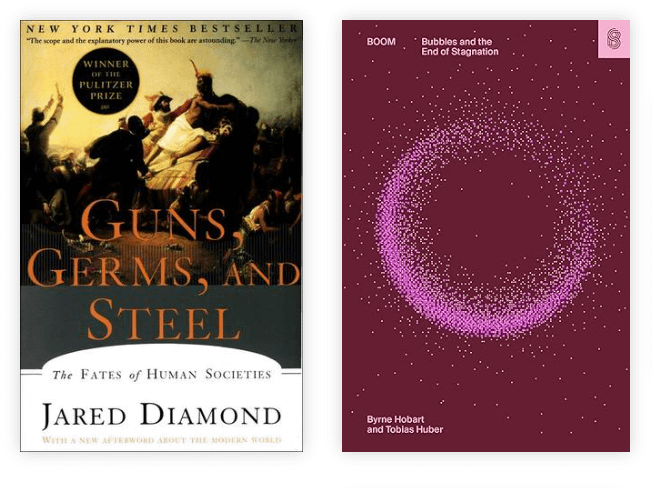
One is a story of the past and another a story of the future. They aren't 100% compatible with each other (one rejects the great man theory while the other kind of supports it).
But coupled together, they can give you a bird's-eye view of the world and where we are headed if we are courageous enough to pursue the future.
Guns, Germs, and Steel grapples with the question of "why did some countries develop faster while others lagged behind?". He starts the search and looks into common explanations, the most common one is the racist one, that some races are superior to others. But over the course of the book, he shows how this is a mistake, and goes on to describe the key things that caused one civilization to overcome another through anthropological comparisons(comparing Asian, African, European, and Austronesian civilizations).
He starts narrating how societies developed in different environments, environments where there was a greater variety of domesticable animals and domesticable seeds ended up developing faster than others. Environments that were more connected to others also developed faster. And he goes on to analyze how, in each continent, this has played out:
- Khoisan hunter-gatherers being driven out by Bantu farmers in Africa.
- Maori Farmers killing the Moriori hunter-gatherers.
- Later on, European farmers dominating America.
Basically, more resources available -> societies became more complex and bigger -> more germs spread -> when arriving in less developed societies, the germs played a big role by killing the population that didn't develop imunity beforehand.
It is a fascinating read and serves as a good foundation for ancient historical knowledge and what the waves of colonization were over time. It's very interesting to see how in one century some people were colonizers while in the other they were colonized.
It serves well against presentism(believing our problems are worse than they are because of our lack of historical context).
Then comes Boom, Bubbles, and the end of Stagnation. It is a great read on several bubbles throughout history and how it served to create huge bursts of innovation. If you have never read about the computer industry or the space program, or even how we started sailing across the oceans, it's a great summary.
But what made this book remarkable to me is that I still remember growing up and seeing people excited about new technology; it was this feeling of "the future is going to be better" that inspired me to study engineering. But now all I see is tech despair and the feeling that we aren't headed in a good direction. That we should stop all technology advancements now and be done with it.
And I think this is a very limited way of seeing the future; it demotivates new generations of engineers and is a horrific strategy for anyone not living in the first world.
Maybe the new technology you see won't radically change your life, living in New York or London or Dubai, but every new tech that becomes cheaper to use and able to be mass produced creates lasting change in developing countries.
Sure, it might not always be good, but it can make kids who would have no private tutor finally get one with an LLM, for example.
Believing the future will be better is a drive of civilization; any civilization that doesn't look into the future dies. Same as humans, if there is nothing you look forward to in the future, the chances that you will sink into depression increase.
If anything, this book is great for those people who want to believe the future will be better but have never met someone in their daily life with that optimism.
Parting Thoughts
I think it's very important to read things that are challenging to you, either the subject isn't something you are 100% familiar with, or its an author you dont particularly like, or even something that goes straight against what you believe.
I've learned far more by being in contact with people who were different than me than the opposite. I don't see why with books it would've been any different.
This year, I started really feeling the power of reading fiction; before, I thought it was something I was just barely consuming, but now I truly feel it shapes the way I act far more than "non-fiction" or "productivity" books ever did.
I now open a question to you, reader: what books did you read this year? What did you like about them? Which did you not like?
Tell me in the comments under this post 😊, and happy new year!


